Riskora vs SafetyBank — Side-by-Side for UK Contractors
SafetyBank is a long-running UK health and safety document service that pairs an online builder with a library of pre-written RAMS, COSHH and policy templates. Riskora is a structured RAMS builder that prompts for hazards by trade. If you are choosing between the two, the question is whether you want a template library or a guided builder.
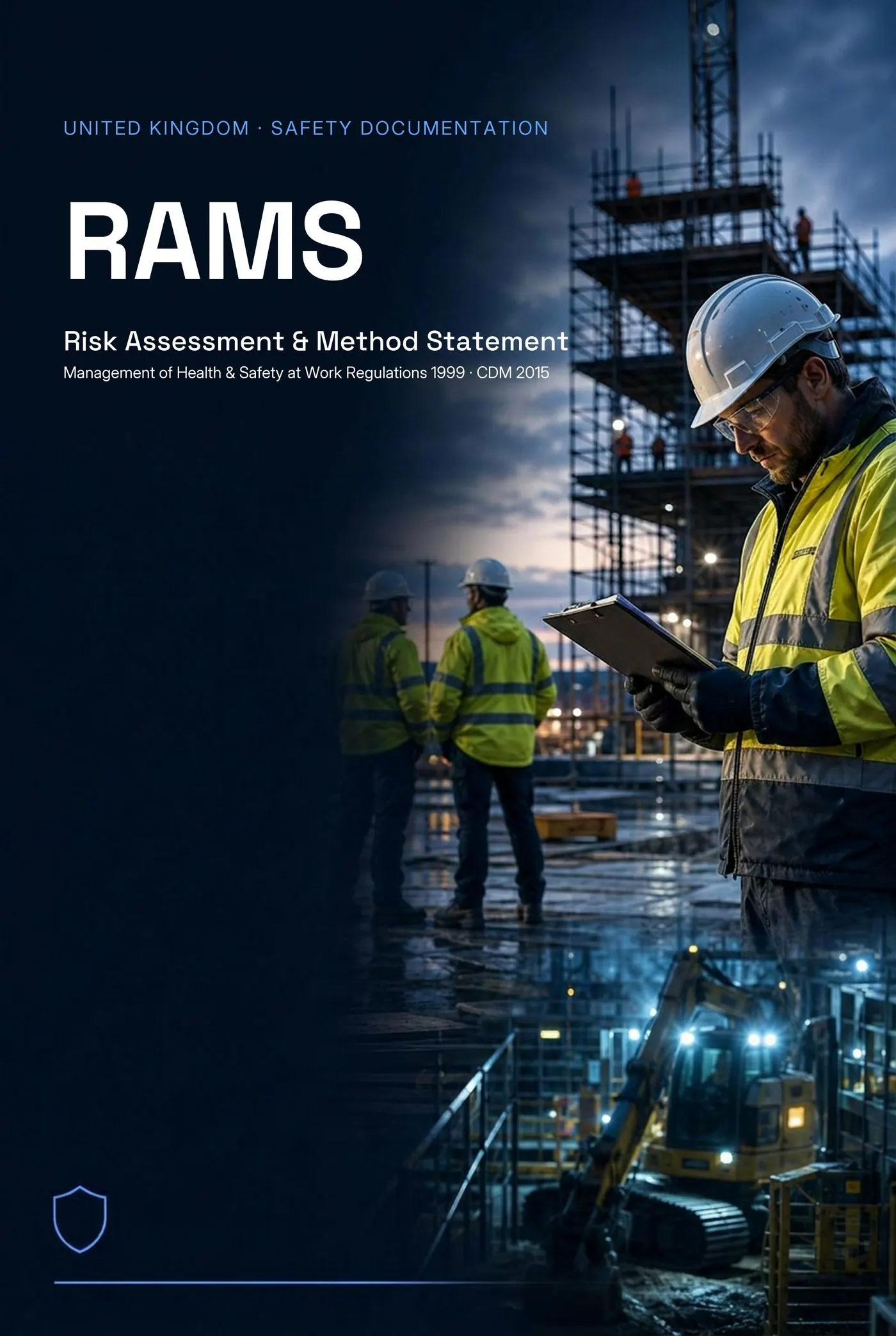
UK (RAMS) example document — Two-Storey Rear Extension — 14 Birchwood Lane, Reading. Client: Mr & Mrs A. Whitfield (Private Client). Site: 14 Birchwood Lane, Reading, RG1 5JT. Scope: Construction of a two-storey rear extension (6.4m × 4.2m) to an existing semi-detached dwelling. Works comprise breaking out of existing rear elevation, trench-fill foundations to 1.0m, traditional cavity blockwork to first floor, pre-stressed concrete lintels, timber roof structure with natural slate finish, plus alterations to existing rear wall to form structural opening with rolled steel joist (RSJ 203×102 UB23). Works programmed over 9 weeks with a peak site team of 6 operatives. Hazards assessed: Manual handling — blocks, lintels, plasterboard, Working at height — independent scaffold & roof structure, Buried services strike during excavation, Collapse of excavation / trench wall, Hand-arm vibration (HAVS) — breaking out, drilling, Silica dust — cutting blocks, brick, concrete, Vehicle/pedestrian segregation — narrow domestic street.
Full version
No card required · 1 lifetime safety document · Upgrade when you need more
What is the difference between Riskora and SafetyBank?
SafetyBank gives you access to a library of ready-written RAMS templates that you customise. Riskora walks you through a structured builder that prompts you with the hazards relevant to your work, then generates a site-specific RAMS. Templates are faster on the first use; the builder produces more genuinely site-specific documents that are less likely to be rejected at induction.
How we compared Riskora and SafetyBank
Both tools were tested in April 2026 by producing the same RAMS — a one-day domestic loft-insulation install with COSHH-relevant materials — for a sole-trader insulation contractor.
- Time-to-first-finished-RAMS, from sign-up to PDF
- Site-specificity of the output (named hazards, named operatives, named materials)
- Document QA — flagging generic content before download
- Adjacent libraries: COSHH, policies, procedures
- Governance: RBAC, SSO, version locking, audit download
- Annualised cost for a 1–3 person firm
Assessment period: April 2026. Riskora is our own product — comparison points for other tools reflect publicly available information at the time of review.
Feature Comparison
| Feature | Riskora | SafetyBank |
|---|---|---|
| Approach | Structured builder + QA engine | Template library + editor |
| RAMS builder | ||
| Trade-specific hazard prompts | ||
| Document QA engine (flags generic content) | ||
| Role-based access (RBAC) & SSO | ||
| Version control & review locking | ||
| Audit-ready bulk download packs | ||
| Compliance calendar / review reminders | ||
| Projects / sites organisation | ||
| COSHH library | no (RAMS-focused) | |
| Document download | ||
| Training required | None | Self-serve |
| Free account | free account | Limited preview |
| Starting price | £29/mo, transparent | From around £30/mo |
Individual Tool Breakdowns
SafetyBank
SafetyBank is a UK health and safety platform offering pre-written RAMS, COSHH, policies and procedures alongside a document editor. It is positioned as an all-in-one H&S documentation service for SMEs.
Best for: Small-to-medium UK businesses that want a broad library of H&S documents — RAMS plus COSHH, policies and procedures — and are happy with template-based customisation.
Strengths
- Large library of pre-written documents
- Covers COSHH, policies and procedures alongside RAMS
- Mature product with long UK trading history
- Useful for businesses needing a one-stop H&S document source
Limitations
- Template-based — RAMS still need careful customisation to avoid 'looks generic' rejection
- Bigger feature set means more learning curve than a focused builder
- Pricing tiers can include features SMEs do not use
- RAMS library quality depends on how well the user adapts the chosen template
Common Questions Before Getting Started
Will this take long?
Under 5 minutes. Select your trade, pick hazards, download.
Is it complicated?
No training needed. The guided builder walks you through every step.
Do I need experience?
If you know what work you're doing, you can use Riskora.
Is it free to try?
Yes. The Free plan needs no card — generate, review and download one free PDF. Upgrade any time for branding, sign-off and higher limits.
Worked head-to-head: same loft-insulation brief, both tools
We ran the same brief — a one-day loft insulation install for a domestic semi-detached property, sole trader, mineral-wool batts and a foil vapour barrier, working from a loft hatch — through both tools.
- Riskora: signed up self-serve, picked the "Insulation install" preset, confirmed 8 pre-loaded hazards (fall through ceiling, manual handling of batts, dust and fibres, restricted working space, electrical contact with concealed cabling, hot loft conditions, etc.), added the property address and the operative's CSCS card. QA prompted for FFP3 (not a dust mask) and flagged "ceiling joists checked" as too vague — asked for the inspection method. Downloaded a 9-page PDF at 4 min 40s.
- SafetyBank: logged in, searched the template library for "insulation", downloaded the closest match (a generic loft-insulation PDF template). Editing the document to remove generic wording, add the property details, swap mask grades and remove three irrelevant hazards took 38 minutes. The resulting RAMS is fine — but the path of least resistance was to leave the original wording in place, which is the failure mode HSE inspectors flag at induction.
The honest read: SafetyBank produces a defensible RAMS faster than starting from a blank page, but slower than a structured builder, and the document is only as site-specific as the user makes it. Riskora's QA engine catches the "generic-content" failure mode automatically. For a sole trader producing a RAMS per job, the builder model is materially faster; for a contractor who also wants a COSHH library and full company policies, SafetyBank covers more ground.
Why generic-looking RAMS get rejected at induction
The single most common reason a principal contractor's H&S team rejects a subcontractor RAMS is "lack of site specificity" — the document clearly describes a generic activity rather than the actual job. This is the failure mode the template approach is most vulnerable to.
- Named operatives missing or generic. "Site operative" instead of "Tom Reynolds, CSCS card 8294432, asbestos awareness valid to 14 March 2027".
- Generic controls. "PPE worn", "site cleaned regularly", "work carried out safely". Each is a sentence that says nothing — and HSE inspectors recognise the pattern instantly.
- Hazards that don't apply. A loft-insulation RAMS that lists "trench collapse" or "lifting operations" shows the template hasn't been adapted.
- Wrong PPE grade. "Dust mask" or "FFP2" for jobs that require FFP3 (most insulation, most stripping out, most cutting).
A structured builder with a QA engine — Riskora's approach — prevents these at source. A template library — SafetyBank's approach — relies on the user catching them during editing. Both can produce a good RAMS; one makes the failure mode less likely.
Why Teams Choose Riskora
The honest comparison comes down to structure and site specificity. A template library — SafetyBank, HASpod or a free download — gives you a head start, but every section still needs to be rewritten for the actual job. Riskora prompts you with hazards relevant to the work, lets you confirm or remove them, and flags content that still looks generic before download. That supports a more consistent review process, but the competent person remains responsible for the final document and the receiving contractor decides whether it is acceptable. Riskora also adds role-based access, SSO, version control with review locking, bulk download packs and a compliance calendar. If you need a COSHH library and full company policies in one place, SafetyBank covers more ground. If your priority is a guided RAMS workflow with document governance, Riskora is the more focused choice.
When SafetyBank is the better choice
Cases where SafetyBank's template-library model fits better than Riskora's structured builder:
- If You need a COSHH library alongside RAMS — chemical assessments for cleaning products, solvents, paints — SafetyBank — the COSHH library is mature and Riskora does not match it.
- If You also need company H&S policies, employee handbooks and procedures from one source — SafetyBank — bundled documents are a genuine time-saver if you'll use them.
- If You prefer Word templates you can fully customise outside the tool — SafetyBank — the editable downloads suit teams who want to own the source file.
- If You produce fewer than 3 RAMS per year and only need an occasional document — SafetyBank or the HSE's free example documents — full software is overkill at that volume.
All documents should be reviewed by a competent person before use on site.
Frequently Asked Questions
Is SafetyBank good value?
It is reasonable value for a business that uses the full library — RAMS, COSHH, policies, procedures. For a contractor whose only need is RAMS, paying for a full H&S library is more than they need.
Can I use Riskora for COSHH assessments?
Riskora generates risk assessments and method statements (RAMS). It does not currently include a COSHH-specific library, although COSHH-relevant hazards do appear in the relevant trade prompts.
Which produces better-quality RAMS?
Both can produce sign-off-ready RAMS in skilled hands. The structured-builder approach (Riskora) has the advantage that the document is necessarily built from your specific inputs; the template approach (SafetyBank) has the disadvantage that the document is only as site-specific as the user makes it.
Can I switch from SafetyBank to Riskora?
Yes. There is no automated migration, but Riskora's builder is fast enough that recreating your typical RAMS during a free account takes minutes rather than hours.
Ready? It takes less than 5 minutes.
No training. No complex setup. Just select your trade and go.
No card required · 1 lifetime safety document · Paid tiers add branding, sign-off and audit trails
Try Riskora free — preview a site-specific RAMS before sign-up
Generate a preview first. Sign up only when you want to save, edit or export.
Final RAMS must be reviewed and approved by a competent person before use.
Riskora is an assistive document preparation tool. All documents generated must be reviewed, verified, and approved by a competent person before use on site. Riskora does not replace professional safety judgment, and no output should be treated as a legal compliance guarantee.