Method Statement Software for UK Contractors
By the Riskora Editorial Team · Written to our editorial standards
Create a clear, professional method statement in minutes. Riskora brings your work sequence, hazards and precautions together in a guided workflow, ready to review and download as a PDF.
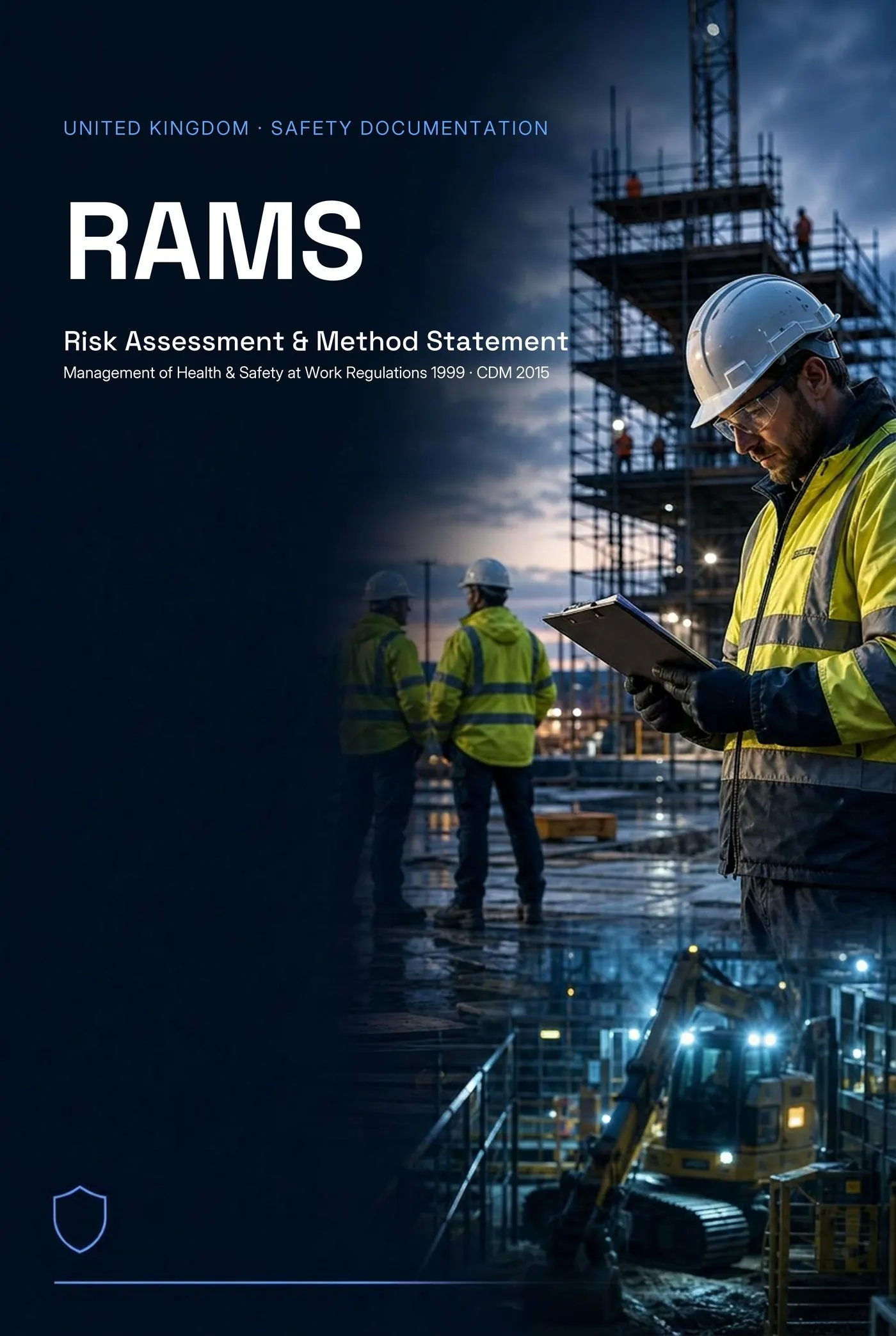
UK (RAMS) example document — Two-Storey Rear Extension — 14 Birchwood Lane, Reading. Client: Mr & Mrs A. Whitfield (Private Client). Site: 14 Birchwood Lane, Reading, RG1 5JT. Scope: Construction of a two-storey rear extension (6.4m × 4.2m) to an existing semi-detached dwelling. Works comprise breaking out of existing rear elevation, trench-fill foundations to 1.0m, traditional cavity blockwork to first floor, pre-stressed concrete lintels, timber roof structure with natural slate finish, plus alterations to existing rear wall to form structural opening with rolled steel joist (RSJ 203×102 UB23). Works programmed over 9 weeks with a peak site team of 6 operatives. Hazards assessed: Manual handling — blocks, lintels, plasterboard, Working at height — independent scaffold & roof structure, Buried services strike during excavation, Collapse of excavation / trench wall, Hand-arm vibration (HAVS) — breaking out, drilling, Silica dust — cutting blocks, brick, concrete, Vehicle/pedestrian segregation — narrow domestic street.
Full version
What is a method statement?
A method statement is a document that describes how a work activity will be carried out safely. It typically includes the scope of works, step-by-step procedures, required resources, and safety precautions. In the UK, method statements are commonly paired with risk assessments to form a RAMS.
Why Writing Method Statements Takes Too Long
Rebuilding the structure, reformatting the same sections and checking old job details can turn a straightforward method statement into repetitive admin. A guided workflow keeps the document organised while you focus on what changes for the site.
How Riskora Helps
Riskora guides you from scope and site details to the work sequence, hazards and precautions, bringing the method statement and risk assessment into one professional RAMS PDF. Industry presets and Safety QA support the process. Start with one lifetime safety document free, with no card required; paid plans add sign-off, branding, reuse and team records.
Who it's for
- Subcontractors preparing method statements for main contractor approval
- Project managers requiring consistent documentation across trades
- Small contractors producing method statements for tender submissions
- Safety teams reviewing and standardising method statement quality
Understand the Fundamentals
Before you generate your document, these guides cover the knowledge that underpins every good RAMS, risk assessment, and method statement.
Method Statements Explained
What a method statement is, when you need one, and how to write one that's fit for purpose.
What Must Be Included
The key sections every method statement should contain.
RAMS vs Risk Assessment
Understanding the difference between RAMS, risk assessments, and method statements.
Are method statements a legal requirement in the UK?
HSE describes method statements as a practical way to plan and communicate safe working methods. Some activities have specific written-planning duties: demolition and dismantling arrangements must be recorded before work starts under CDM 2015 Regulation 20. Check the requirements for the activity and location; CDM 2015 applies in Great Britain.
What should a method statement include?
Describe the scope, work sequence, equipment, precautions, responsibilities and emergency arrangements for the job. Link the sequence to the risk assessment and relevant site information, then review it with the people responsible for the work.
What UK Law Actually Says
Direct quotes from the named regulations, with plain-English explanations of what each one means in practice.
Regulation 15(2), Construction (Design and Management) Regulations 2015 — excerpt
“A contractor must plan, manage and monitor construction work”
In Great Britain, contractors must plan, manage and monitor their work so that it is carried out, so far as is reasonably practicable, without risks to health and safety. A method statement records the planned sequence and precautions; supervision and checking those arrangements on site put the plan into practice.
Read the source on legislation.gov.uk →Section 2(2)(a), Health and Safety at Work etc. Act 1974 — excerpt
“the provision and maintenance of plant and systems of work”
This provision concerns plant and systems of work that are, so far as is reasonably practicable, safe and without risks to health. Riskora helps you organise and communicate the method and precautions in a clear document for the team.
Read the source on legislation.gov.uk →The Numbers Behind the Risk
Why this matters — the most recent published figures from the Health and Safety Executive and ONS.
25 construction worker deaths
HSE's provisional Great Britain figures for 2025/26 report 25 fatal injuries to construction workers across all accident types. These figures underline the importance of planning and implementing safe work.
Source: HSE — Fatal injuries 2025/26 (provisional) →31 fatal falls from height
Across all industries in Great Britain, HSE provisionally reports 31 worker deaths from falls from height in 2025/26. This is not a construction-only total or a measure of method-statement quality.
Source: HSE — Fatal injuries 2025/26 (provisional) →Illustrative planning brief: a soft-strip demolition job
Consider a proposed soft strip in an older office building with people occupying another part of the premises. Before writing the method, establish the scope, survey information, structural constraints, service isolations and access arrangements with the people responsible for the work.
Use the method statement to organise the agreed sequence, responsibilities, separation from occupants, material-handling arrangements and dust controls. Reference the relevant asbestos survey, drawings and specialist plans, and identify the checks that must be completed before each stage proceeds.
Riskora helps turn that job information into a structured document in minutes, with a professional PDF ready for review and briefing. This is an illustrative planning brief, not a complete demolition method or a timed customer case study. The actual sequence and controls must be established for the building and work involved.
Common Mistakes (and How to Avoid Them)
1. Using a generic description instead of a clear work sequence
Why it fails: A general promise to work safely does not explain how the task will be organised or which precautions apply at each stage.
Fix: Set out the sequence, controls and responsibilities so the people doing and supervising the work can follow the plan.
2. Leaving out relevant design and site information
Why it fails: The planned method needs to reflect the actual structure, access, services and any temporary works, rather than assumptions carried over from another job.
Fix: Reference the relevant surveys, drawings and temporary-works designs, and identify checks needed before work proceeds.
3. Updating the method statement without checking the risk assessment
Why it fails: Changes to the work sequence can introduce hazards or make an existing control unsuitable.
Fix: Review the sequence and assessment together, then issue the current version and brief the team on the changes.
Method-statement guidance and plan details
Sources checked on 30 September 2026. The legislation cited here applies in Great Britain; check the applicable Northern Ireland framework for work there.
Key Features
- Guided work sequence alongside the risk assessment
- Industry presets and editable job-specific content
- Professional PDF output and Safety QA
- Competent-person sign-off from Starter
- Branding, document reuse and basic version history from Pro
- Projects, roles, crew briefings and locked versions from Team
Common Questions Before Getting Started
Will this take long?
Under 5 minutes. Select your trade, pick hazards, download.
Is it complicated?
No training needed. The guided builder walks you through every step.
Do I need experience?
If you know what work you're doing, you can use Riskora.
Is it free to try?
Yes. The Free plan needs no card — generate, review and download one free PDF. Upgrade any time for branding, sign-off and higher limits.
Create your RAMS in under 5 minutes
No onboarding or setup needed — start generating documents instantly
Try Riskora FreeNo card required · 1 lifetime safety document · Upgrade when you need more
All documents generated by Riskora should be reviewed by a competent person before use on site. Riskora provides structured templates — professional judgement is always required.
What your RAMS actually contains
Riskora builds a structured, client-facing document — not a generic AI paragraph. Every section is shaped around your job, your site and your team.
Hazards
Task-specific hazards for the job, captured row by row — not a generic list pulled from an old RAMS.
Controls
Control measures mapped to each hazard with residual risk scoring after controls are applied.
PPE
PPE requirements tied to the activity and site, ready to brief to the team.
Method steps
Step-by-step method statement structured around how the work is actually sequenced on site.
Emergency arrangements
First aid, rescue plan, emergency contacts and site-specific escalation routes.
COSHH prompts
Substance prompts when the work involves chemicals, dusts, fumes or sealants — flagged early, not missed at review.
Sign-off
Operative sign-off captured against the document — names, dates and acknowledgement of the brief.
Version history
Every change tracked so you can show what was issued, when, and which version the team signed.
Approval status
Clear approval state on every document — draft, in review, approved, issued — visible across the team.
Audit trail
Who created it, who reviewed it, who signed it. A complete trail you can hand to a principal contractor or auditor.
From copied-and-pasted to site-specific
The reason RAMS get rejected is rarely the format — it's that the document is obviously generic. Riskora rebuilds it around this job, this site and this task.
Generic template copied from an old job.
- • Hazards and controls that don't match this site or task.
- • Method steps written for a different sequence of work.
- • No emergency arrangements specific to the location.
- • Client flags it as generic and asks for a rewrite.
Site-specific document structured around this job, site and task.
- • Hazards captured from the actual scope you pasted in.
- • Method steps sequenced for how the work runs on site.
- • Emergency arrangements and rescue plan tied to the location.
- • Approved internally, briefed to the team, signed off and stored.
From job details to signed-off document
A four-step workflow used by contractors, consultants and safety teams to turn informal job details into client-ready safety paperwork.
- 1Paste job details
Drop in a client email, a WhatsApp from the site manager, a scope of works or a tender note. Anything that describes the job.
- 2Riskora structures the document
Riskora turns your brief into hazards, controls, method steps, PPE, emergency arrangements and COSHH prompts.
- 3Review, edit and download
You stay in control of every section. Tweak anything, then download a clean PDF or share a link.
- 4Brief the team and record sign-off
Brief operatives, capture their sign-off and keep a full audit trail of who signed which version.
Built by people who've written this paperwork on real sites
Riskora is built by a founder with hands-on site and document experience — designed for contractors, consultants and safety teams who need to issue, brief and prove safety paperwork without losing a day to admin.
- Built for contractors, consultants and teams
Solo trades, principal contractors and in-house safety teams all run on the same workflow. - Supports multiple countries
UK, Ireland, Australia, New Zealand, US and Canada — wording and document types match the local standard. - Not just documents
Sign-off, approvals, version history and an audit trail — the management workflow around the paperwork.
Frequently Asked Questions
Describe your job — your draft is one paragraph away.
No training. No complex setup. Just select your trade and go.
Related Pages
References & Further Reading
Primary UK sources covering the legal and practical framework behind RAMS, risk assessments and method statements.
Try Riskora free — preview a site-specific RAMS before sign-up
Generate a preview first. Sign up only when you want to save, edit or export.
Final RAMS must be reviewed and approved by a competent person before use.
Riskora is an assistive document preparation tool. All documents generated must be reviewed, verified, and approved by a competent person before use on site. Riskora does not replace professional safety judgment, and no output should be treated as a legal compliance guarantee.