Method Statement Examples (UK Construction)
By the Riskora Editorial Team · Written to our editorial standards
UK method statements should be specific enough that the foreman can run the job from the document. Most online examples aren't — they're trade-generic wallpaper. The five examples below are written the way principal contractors and CHAS reviewers actually expect, with the sequence, plant, access and emergency response named. Free first PDF, no card.
UK (RAMS) example document — Two-Storey Rear Extension — 14 Birchwood Lane, Reading. Client: Mr & Mrs A. Whitfield (Private Client). Site: 14 Birchwood Lane, Reading, RG1 5JT. Scope: Construction of a two-storey rear extension (6.4m × 4.2m) to an existing semi-detached dwelling. Works comprise breaking out of existing rear elevation, trench-fill foundations to 1.0m, traditional cavity blockwork to first floor, pre-stressed concrete lintels, timber roof structure with natural slate finish, plus alterations to existing rear wall to form structural opening with rolled steel joist (RSJ 203×102 UB23). Works programmed over 9 weeks with a peak site team of 6 operatives. Hazards assessed: Manual handling — blocks, lintels, plasterboard, Working at height — independent scaffold & roof structure, Buried services strike during excavation, Collapse of excavation / trench wall, Hand-arm vibration (HAVS) — breaking out, drilling, Silica dust — cutting blocks, brick, concrete, Vehicle/pedestrian segregation — narrow domestic street.
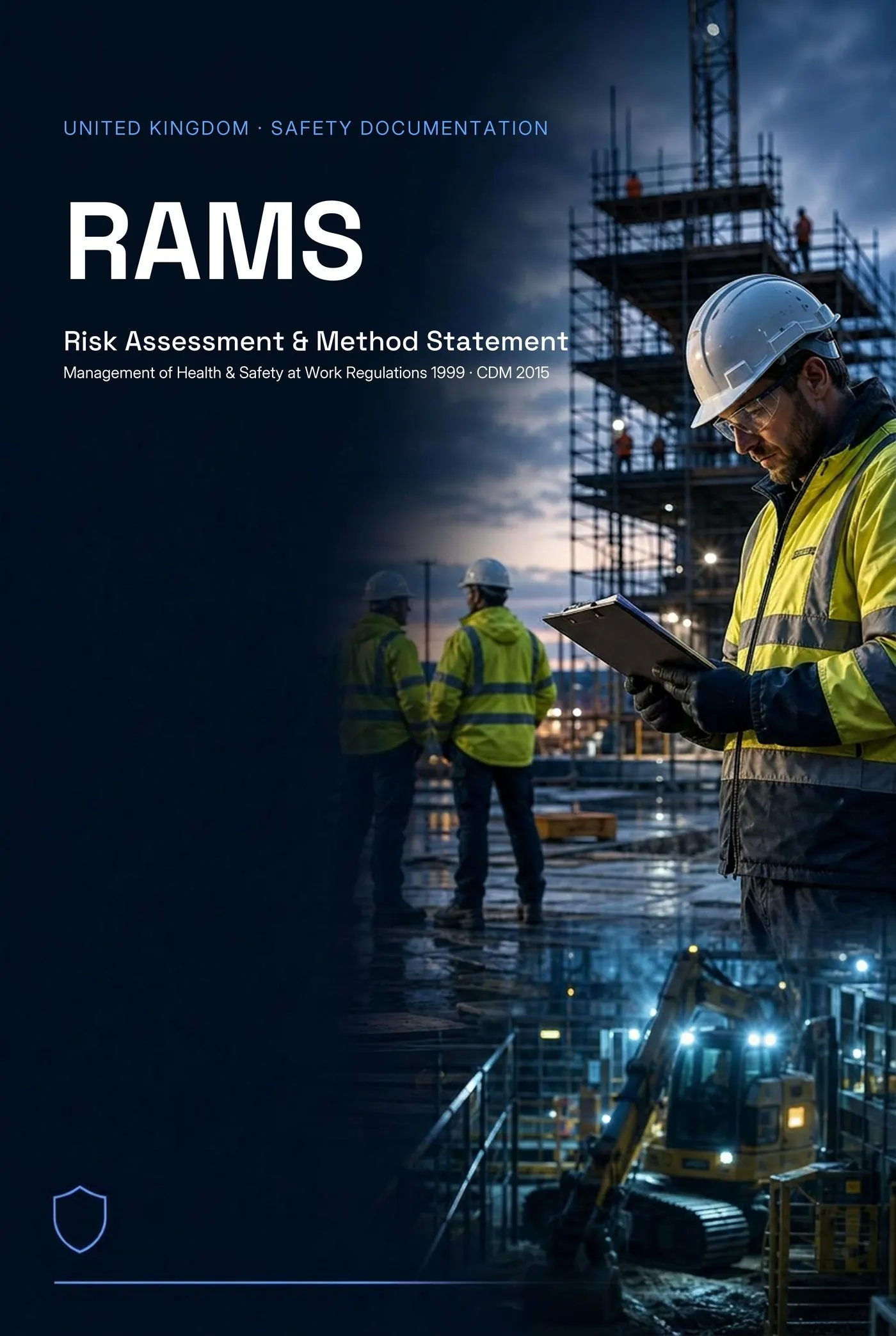
Full version
What does a UK method statement need to include?
Project details (client, site address, programme), scope of works in one or two sentences, the step-by-step safe sequence of work, plant and equipment list with inspection/cert status, access and egress arrangements, the linked risk assessment reference, permit requirements (hot works, confined space, permit-to-dig), emergency arrangements (first-aider, RV, F1 hospital), and a named competent reviewer with date.
Why most online method statement examples fail at induction
Search results for "method statement example" are dominated by Word templates that read like a job description ("works will be carried out safely"). They give the reviewer nothing to verify. The principal contractor's induction will pull you up on it — sequence missing, plant not listed, emergency RV blank. Worse, on a CDM-notifiable site you can't start work without an accepted MS. For the wider picture see the complete UK guide to RAMS.
How Riskora Helps
Riskora produces method statements built sequentially — site setup, access, isolation, main activity, quality check, demobilisation — with trade-appropriate detail at each step. The examples below show the depth expected; the free wizard above produces the same structure from your inputs. Compare against the wider UK method statement software.
Who it's for
- Flat-roof recovering and hot works
- Groundworks and service trenches
- Demolition and soft strip
- Electrical second-fix in occupied premises
- Lifting operations with mobile cranes
- Scaffolding erection and dismantling
Understand the Fundamentals
Before you generate your document, these guides cover the knowledge that underpins every good RAMS, risk assessment, and method statement.
What Must Be in a Method Statement?
Every section a UK method statement needs — from scope and sequence to emergency procedures.
Method Statements Explained
What a method statement is, how it differs from a risk assessment, and when you need one.
Risk Assessment Examples (UK)
The risk-assessment side of a UK construction RAMS pack.
RAMS Examples
Full combined risk assessment + method statement examples.
How to Write a RAMS Document
Step-by-step guide to producing the full pack reviewers expect at induction.
Best UK Method Statement Software
How Riskora compares to HandsHQ, HASpod and EcoOnline for method statement production.
How long should a method statement be?
Long enough that a competent worker could run the job from it, but short enough to be read at induction — usually 3 to 8 pages. Anything beyond that is usually a bundle of jobs that should each have their own MS, or padding that nobody reads on site.
Method statement vs risk assessment — what's the difference?
A risk assessment identifies the hazards and scores the risk. A method statement describes the safe sequence of work that controls those hazards. Together they form a RAMS pack — almost every UK principal contractor expects both, cross-referenced.
Who writes the method statement?
The contractor doing the work — they understand the actual sequence, plant and crew. A site manager, foreman or safety advisor reviews it before submission. The reviewer needs to be competent in the work, which usually means SMSTS, IOSH or trade-specific qualifications.
Key Risks and Considerations
- •Generic sequence that could apply to any job
- •No plant register or inspection status
- •Emergency RV / first-aider left blank
- •No linked risk assessment reference
- •MS issued without a named competent reviewer
What UK Law Actually Says
Direct quotes from the named regulations, with plain-English explanations of what each one means in practice.
Regulation 15(4), Construction (Design and Management) Regulations 2015
“The principal contractor must prepare a written plan (the 'construction phase plan'), and ensure that it identifies the health and safety risks involved in the work and the precautions necessary to address them.”
The construction phase plan is the umbrella document; each contractor's method statement is one of the inputs. An MS that doesn't connect to the CPP fails the integration test the first time a principal contractor's safety advisor audits it.
Read the source on legislation.gov.uk →Regulation 9, Provision and Use of Work Equipment Regulations 1998
“Every employer shall ensure that all persons who use work equipment have received adequate training for purposes of health and safety, including training in the methods which may be adopted when using the work equipment, any risks which such use may entail and precautions to be taken.”
PUWER 1998 reg 9 is why method statements name the plant and the operator's competency in the sequence — not as an afterthought. If the MS lists a MEWP, it must say who is IPAF-trained to operate it.
Read the source on legislation.gov.uk →The Numbers Behind the Risk
Why this matters — the most recent published figures from the Health and Safety Executive and ONS.
51 construction worker deaths
Construction remained the highest-fatality sector in 2023/24. Falls from height dominate — exactly the failure mode method statements are written to control by specifying access, edge protection and rescue arrangements step by step.
Source: HSE — Construction sector statistics 2023/24 →~5,000 RIDDOR construction injuries
Annual non-fatal RIDDOR injuries in the construction sector. The majority involve a missing or generic method statement — the activity proceeded without the safe sequence being defined for the actual site.
Source: HSE — Construction sector statistics 2023/24 →Side-by-side: a generic vs a passing method-statement step
Weak example. Step 3: "Carry out roofing works safely using appropriate equipment and PPE. Follow site rules and report any hazards." This is the line in 70% of free templates.
Passing example. Step 3: "Strip existing felt — operative on MEWP (Genie Z45, LOLER cert 12 Jul 2026), harness clipped to designated anchor only when MEWP is repositioned, banksman on the ground enforcing the 3m exclusion zone marked by Heras with mesh debris netting on the public footpath side. Felt to skip via enclosed chute. Asbestos refurbishment survey (Ref ASB-2026-114) reviewed pre-start and confirms no ACMs. Stop work and contact site manager if any suspicious material is uncovered."
Why the second one passes. The step is observable — a reviewer can stand at the kerb and tick whether the MEWP cert is in date, whether the Heras is up, whether the banksman is present. The "stop work and contact" sentence builds in the change-control trigger CDM requires.
Common Mistakes (and How to Avoid Them)
1. Sequence written as a paragraph instead of numbered steps
Why it fails: Reviewers and operatives need to tick steps on site. A paragraph forces them to re-read the document every time the job pauses.
Fix: Use numbered steps. Each step names the action, the plant, and the PPE in one line.
2. Plant listed without certificate dates
Why it fails: MEWPs, lifting accessories and excavators need in-date LOLER / PUWER / Thorough Examination. Reviewers check the dates against the site visit date.
Fix: Plant register lists make, model, asset ID and the in-date certificate reference.
3. Emergency arrangements left as a placeholder
Why it fails: Site induction will ask the first-aider's name and the RV point. A blank field is the most common reason inductions stall.
Fix: Name the first-aider, muster point, F1 hospital and fire route on the front sheet of the MS.
4. MS issued without a linked risk assessment
Why it fails: The MS describes the safe sequence; the RA explains why. Without the link, the controls in the sequence have no justification.
Fix: Cross-reference the RA number on the front sheet — the wizard auto-generates the reference when both documents are produced together.
Five worked method statement examples (UK construction)
1) Flat-roof recovering with hot works. Sequence: (1) site setup — exclusion zone, fire watch position, RV point identified; (2) MEWP access — daily LOLER check, ground bearing confirmed, banksman; (3) strip existing felt — manual to skip, asbestos refurbishment survey reviewed pre-start; (4) primer + torch-on cap sheet — hot-works permit issued daily, 60-min fire watch after last torch use; (5) finishing — perimeter trim, photographic handover; (6) demobilisation — fire watch closes 60 min after last torch, equipment off site by 17:00. Plant: Genie Z45 MEWP (LOLER 12 Jul 2026), 2 × propane torches, 2 × 9kg DCP extinguishers. Permits: hot works permit, daily. Linked RA: RA-HW-2026-114.
2) Service trench in domestic front garden (gas). Sequence: (1) CAT & Genny scan + utility plans reviewed; (2) Heras barrier + covered walkway across pavement; (3) hand-dig first 600mm; (4) excavator dig to 1.2m max, banksman in slot; (5) trench box for any depth >1.2m; (6) bed and lay PE pipe; (7) backfill in 150mm layers, compact, reinstate. Plant: 3T mini-excavator (Thorough Examination 22 Apr 2026), CAT4+ & Genny, trench box set. Permits: permit-to-dig, signed off pre-start. Linked RA: RA-GW-2026-201.
3) Soft strip of Victorian terrace pre-refurb. Sequence: (1) refurbishment asbestos survey reviewed; (2) electrical isolation cert held on site; (3) negative-pressure enclosure to ground-floor rear; (4) RPE issued, fit-test recorded; (5) plaster, joinery and floor coverings removed to skip; (6) DOP test daily; (7) clearance before next trade. Plant: M-class vacuum, NPU H-class HEPA. Permits: isolation, hot-works (if any). Linked RA: RA-SS-2026-088.
4) Second-fix lighting in occupied office. Sequence: (1) evening shift starts at 18:00, building unoccupied; (2) permit-to-work + isolation cert; (3) floor-stand barriers in the affected corridor; (4) install 24 LED panels via Class 1 stepladder; (5) test & commission; (6) demob and re-energise; (7) handover by 06:00. Plant: fibreglass platform steps (inspected daily), Megger MFT1741+ (calibrated Mar 2026). Permits: isolation + permit-to-work. Linked RA: RA-EL-2026-329.
5) Mobile crane lift — air-handling unit to flat roof. Sequence: (1) Appointed Person produces lift plan; (2) ground bearing confirmed; (3) outriggers down, mats in place; (4) slinger/signaller briefed, banksman in position; (5) tag lines on load; (6) lift, swing, land; (7) AHU unstrapped and secured; (8) crane derig, escorted off site. Plant: 60T mobile crane (Thorough Examination 9 Mar 2026), certified rigging set. Permits: lift plan signed by AP. Linked RA: RA-LIFT-2026-017.
Each sequence is illustrative — the equipment IDs, certificate dates and crew details are the difference between a real MS and a template that gets rejected at induction.
What reviewers (principal contractors, CHAS, HSE) check first
- Sequence specificity. Step numbers, not paragraphs. Each step names the action, plant and PPE.
- Plant register with certs. LOLER, PUWER, Thorough Examination and calibration dates beside each item.
- Linked RAMS reference. The risk assessment number on the front sheet, with hazards mirrored.
- Permits identified. Hot works, permit-to-dig, confined space, isolation — named with issue routine.
- Emergency RV. Named first-aider, muster point, F1 hospital, fire route.
From the examples to your own document
The free wizard above takes a one-line description and walks the same sequence — site setup → access → main activity → quality → demob — adding trade-appropriate plant, permits and emergency arrangements as it goes. First PDF is free with no card.
For the matching risk assessment side, see the UK risk assessment examples, and to understand how MS + RA combine into a single submission see RAMS examples.
Key Features
- Step-by-step sequence builder with trade presets
- Plant & equipment register with inspection field
- Linked risk assessment cross-reference
- Permit / isolation / emergency RV block
- PDF download structured for principal-contractor review
- Free first document — no card required
Example Structure (UK Standard)
- Front sheet: client, site address, programme, RAMS ref
- Scope: 1–2 sentences naming what gets done
- Sequence: 6–12 numbered steps with plant + PPE at each
- Plant & equipment register with certification status
- Access & egress, exclusion zones, permits required
- Linked risk assessment & COSHH references
- Emergency arrangements: first-aider, RV, F1, fire route
- Reviewer: name, competency, date, review trigger
Common Questions Before Getting Started
Will this take long?
Under 5 minutes. Select your trade, pick hazards, download.
Is it complicated?
No training needed. The guided builder walks you through every step.
Do I need experience?
If you know what work you're doing, you can use Riskora.
Is it free to try?
Yes. The Free plan needs no card — generate, review and download one free PDF. Upgrade any time for branding, sign-off and higher limits.
Create your RAMS in under 5 minutes
No onboarding or setup needed — start generating documents instantly
Try Riskora FreeNo card required · 1 lifetime safety document · Upgrade when you need more
All documents generated by Riskora should be reviewed by a competent person before use on site. Riskora provides structured templates — professional judgement is always required.
What your RAMS actually contains
Riskora builds a structured, client-facing document — not a generic AI paragraph. Every section is shaped around your job, your site and your team.
Hazards
Task-specific hazards for the job, captured row by row — not a generic list pulled from an old RAMS.
Controls
Control measures mapped to each hazard with residual risk scoring after controls are applied.
PPE
PPE requirements tied to the activity and site, ready to brief to the team.
Method steps
Step-by-step method statement structured around how the work is actually sequenced on site.
Emergency arrangements
First aid, rescue plan, emergency contacts and site-specific escalation routes.
COSHH prompts
Substance prompts when the work involves chemicals, dusts, fumes or sealants — flagged early, not missed at review.
Sign-off
Operative sign-off captured against the document — names, dates and acknowledgement of the brief.
Version history
Every change tracked so you can show what was issued, when, and which version the team signed.
Approval status
Clear approval state on every document — draft, in review, approved, issued — visible across the team.
Audit trail
Who created it, who reviewed it, who signed it. A complete trail you can hand to a principal contractor or auditor.
From copied-and-pasted to site-specific
The reason RAMS get rejected is rarely the format — it's that the document is obviously generic. Riskora rebuilds it around this job, this site and this task.
Generic template copied from an old job.
- • Hazards and controls that don't match this site or task.
- • Method steps written for a different sequence of work.
- • No emergency arrangements specific to the location.
- • Client flags it as generic and asks for a rewrite.
Site-specific document structured around this job, site and task.
- • Hazards captured from the actual scope you pasted in.
- • Method steps sequenced for how the work runs on site.
- • Emergency arrangements and rescue plan tied to the location.
- • Approved internally, briefed to the team, signed off and stored.
From job details to signed-off document
A four-step workflow used by contractors, consultants and safety teams to turn informal job details into client-ready safety paperwork.
- 1Paste job details
Drop in a client email, a WhatsApp from the site manager, a scope of works or a tender note. Anything that describes the job.
- 2Riskora structures the document
Riskora turns your brief into hazards, controls, method steps, PPE, emergency arrangements and COSHH prompts.
- 3Review, edit and download
You stay in control of every section. Tweak anything, then download a clean PDF or share a link.
- 4Brief the team and record sign-off
Brief operatives, capture their sign-off and keep a full audit trail of who signed which version.
Built by people who've written this paperwork on real sites
Riskora is built by a founder with hands-on site and document experience — designed for contractors, consultants and safety teams who need to issue, brief and prove safety paperwork without losing a day to admin.
- Built for contractors, consultants and teams
Solo trades, principal contractors and in-house safety teams all run on the same workflow. - Supports multiple countries
UK, Ireland, Australia, New Zealand, US and Canada — wording and document types match the local standard. - Not just documents
Sign-off, approvals, version history and an audit trail — the management workflow around the paperwork.
Frequently Asked Questions
Describe your job — your draft is one paragraph away.
No training. No complex setup. Just select your trade and go.
References & Further Reading
Primary UK sources covering the legal and practical framework behind RAMS, risk assessments and method statements.
Create your examples method statement free — preview before sign-up
Generate a preview first. Sign up only when you want to save, edit or export.
Final RAMS must be reviewed and approved by a competent person before use.
Riskora is an assistive document preparation tool. All documents generated must be reviewed, verified, and approved by a competent person before use on site. Riskora does not replace professional safety judgment, and no output should be treated as a legal compliance guarantee.