RAMS for Soft Strip Demolition (UK) – Generate in Minutes
By the Riskora Editorial Team · Written to our editorial standards
Generate structured RAMS for soft strip and internal demolition — covering asbestos management, service isolation, manual handling of materials, dust suppression, and waste segregation.
UK (RAMS) example document — Two-Storey Rear Extension — 14 Birchwood Lane, Reading. Client: Mr & Mrs A. Whitfield (Private Client). Site: 14 Birchwood Lane, Reading, RG1 5JT. Scope: Construction of a two-storey rear extension (6.4m × 4.2m) to an existing semi-detached dwelling. Works comprise breaking out of existing rear elevation, trench-fill foundations to 1.0m, traditional cavity blockwork to first floor, pre-stressed concrete lintels, timber roof structure with natural slate finish, plus alterations to existing rear wall to form structural opening with rolled steel joist (RSJ 203×102 UB23). Works programmed over 9 weeks with a peak site team of 6 operatives. Hazards assessed: Manual handling — blocks, lintels, plasterboard, Working at height — independent scaffold & roof structure, Buried services strike during excavation, Collapse of excavation / trench wall, Hand-arm vibration (HAVS) — breaking out, drilling, Silica dust — cutting blocks, brick, concrete, Vehicle/pedestrian segregation — narrow domestic street.
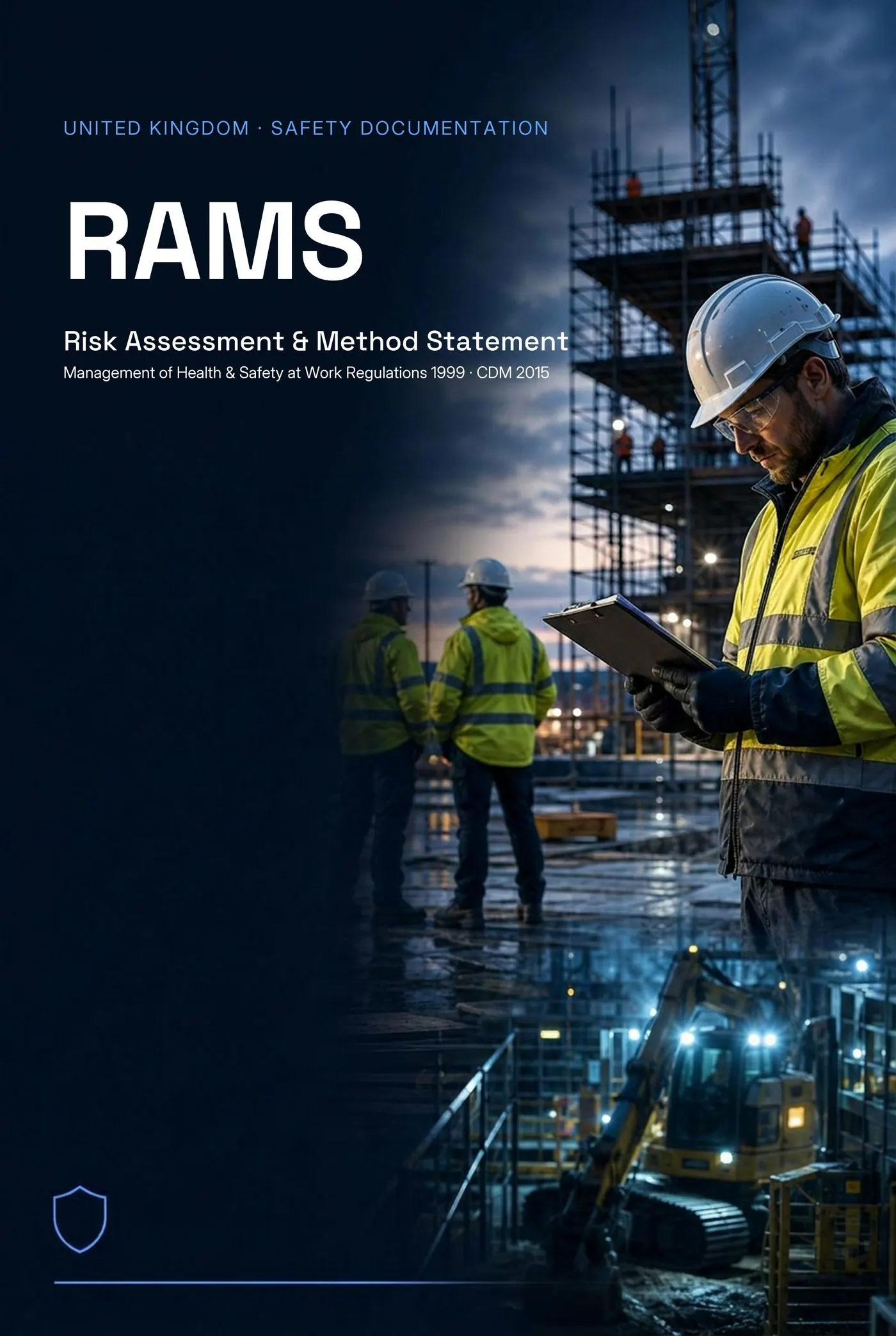
Full version
Takes less than 5 minutes
No card required · 1 lifetime safety document · Upgrade when you need more
What should a soft strip RAMS include?
A soft strip RAMS must cover the scope of strip-out work (fittings, fixtures, internal walls, ceilings, floor coverings), pre-strip asbestos survey findings and management, service isolation confirmations (gas, electric, water), manual handling of removed materials, dust and noise control measures, waste segregation and disposal routes, structural considerations when removing non-load-bearing walls, and the interface with other trades if the building is partially occupied.
Soft Strip Looks Simple — Until Asbestos, Services, and Structure Get Involved
Soft strip — removing internal fittings, fixtures, partition walls, suspended ceilings, floor coverings, and M&E services before structural demolition — is often treated as straightforward manual labour. But it's the phase where asbestos is most likely to be disturbed, where live services get hit because isolation wasn't confirmed, where non-load-bearing walls turn out to be load-bearing, and where dust from decades of accumulated materials fills confined spaces. A soft strip RAMS needs to address the real hazards of ripping out the guts of a building, not pretend it's just tidying up. Understanding the legal requirements for risk assessments in the UK is the first step toward getting your documentation right.
How Riskora Helps
Riskora generates soft strip RAMS covering all phases of internal demolition — from initial site survey through to waste removal. The tool addresses asbestos management, service isolation verification, structural assessment of partition walls, dust and noise control, manual handling of heavy and awkward materials, and waste segregation. Select your building type and strip scope to generate a detailed RAMS. If you're new to RAMS, our step-by-step guide to writing a RAMS explains the fundamentals before you start generating.
Who it's for
- Strip-out contractors preparing RAMS for commercial refurbishment projects
- Main contractors managing soft strip phases before structural demolition
- Fit-out contractors documenting the removal of previous tenant installations
- Housing refurbishment teams stripping kitchens, bathrooms, and heating systems
- Asbestos-aware contractors managing strip-out in pre-2000 buildings
Understand the Fundamentals
Before you generate your document, these guides cover the knowledge that underpins every good RAMS, risk assessment, and method statement.
What Is a RAMS Document?
Understand the two components of a RAMS and why they're required before work begins on site.
How to Write a RAMS Document
A step-by-step guide to structuring your RAMS from project details through to sign-off.
UK Legal Requirements for Risk Assessments
What the law requires under MHSWR 1999 and CDM 2015, and what 'suitable and sufficient' means.
Who Needs a RAMS?
Find out whether your work requires a RAMS and who is responsible for producing one.
Construction Safety Documents Explained
An overview of the key safety documents required on UK construction sites and how they relate to each other.
RAMS vs Risk Assessment — Key Differences
When you need a full RAMS versus a standalone risk assessment, and how the two documents work together.
Key Risks and Considerations
- •Asbestos exposure — disturbing hidden ACMs in ceiling tiles, pipe lagging, floor tiles, textured coatings
- •Service strikes — cutting into walls or floors containing live services not fully isolated
- •Structural instability — removing partitions that provide lateral restraint or support loads
- •Manual handling — heavy doors, sanitary ware, radiators, suspended ceiling grids
- •Dust inhalation — plaster dust, MDF dust, insulation fibres
- •Noise — breakers, reciprocating saws, impact drivers in enclosed spaces
- •Falls from height — working from steps and ladders during ceiling removal
- •Sharps and puncture injuries — exposed nails, screws, glass, and wire
- •Slips and trips — debris, water from cut services, trailing cables
What UK Law Actually Says
Direct quotes from the named regulations, with plain-English explanations of what each one means in practice.
Regulation 5, Control of Asbestos Regulations 2012
“An employer must not undertake work in demolition, maintenance or any other work which exposes or is liable to expose his employees to asbestos in respect of any premises unless either he has carried out a suitable and sufficient assessment as to whether asbestos is or is liable to be present in the premises.”
Soft strip is the highest-risk activity for asbestos exposure — historic floor tiles, textured ceilings, pipe lagging, AIB panels are all common. CAR 2012 Reg 5 makes the R&D survey a legal precondition. No survey, no soft strip, end of.
Read the source on legislation.gov.uk →Regulation 23, Construction (Design and Management) Regulations 2015
“The arrangements for carrying out any demolition or dismantling of a structure must be drawn up before the demolition or dismantling work begins. Such arrangements must be recorded in writing before the demolition or dismantling work begins.”
Soft strip falls within CDM Reg 23's 'dismantling' scope. The written arrangements aren't optional — and they must be in place before any operative starts removing fixtures, ceilings or partitions.
Read the source on legislation.gov.uk →The Numbers Behind the Risk
Why this matters — the most recent published figures from the Health and Safety Executive and ONS.
5,000+ asbestos-related deaths annually
Annual UK deaths attributed to past asbestos exposure — the largest single cause of work-related deaths in the country. Soft-strip and refurbishment workers make up a meaningful share of recent exposure.
Source: HSE — Asbestos-related disease statistics →£500k fines reported in 2023
Combined fines from CAR 2012 prosecutions in 2023 where soft-strip or refurbishment work disturbed unidentified ACMs because the R&D survey was inadequate or absent.
Source: HSE — Recent prosecutions →Worked Example: RAMS for Soft Strip of a 1970s Office Floor
A specialist soft-strip contractor is engaged to strip out the 4th floor of a 1970s office block ahead of refurbishment. The floor is 850m². The R&D survey identifies textured Artex coating to all soffits (chrysotile), AIB panels behind two suspended ceiling tile types, and sprayed limpet asbestos behind one column casing.
The structured builder sequences: (1) R&D survey referenced (UKAS body, surveyor's reg, survey date), (2) all identified ACMs removed under separate licensed contract before soft strip begins, with clearance certificate attached, (3) negative-pressure enclosures dismantled and re-clearance carried out, (4) soft strip commences — ceiling grid, partition studwork, raised floor, electrical first-fix, (5) any unexpected suspect material (UKAS-non-identified) triggers an immediate stop, isolation, and bulk-sample analysis, (6) waste segregation: gen waste, metal recycling, suspect-material in dedicated skip pending lab confirmation, (7) clearance handover with photographic record.
Operatives are IATP asbestos-aware-trained at minimum (no licensed work). Stop-work protocol for any suspect material is briefed daily. RPE (FFP3 minimum) issued for the highest-risk areas with face-fit records held. Total RAMS time: 14 minutes — and the rigour pays for itself the first time an operative correctly stops on a suspect ceiling void.
Common Mistakes (and How to Avoid Them)
1. Beginning soft strip before licensed asbestos removal is fully cleared
Why it fails: ACMs identified in the R&D survey must be removed and the area re-cleared before any soft strip can lawfully begin. Overlapping the two activities is high-risk and CAR 2012 non-compliant.
Fix: Sequence ACM removal as a separate stage with a clearance certificate. Soft strip starts only after the certificate is issued.
2. No stop-work protocol for unexpected suspect material
Why it fails: R&D surveys can miss material — particularly in concealed voids. Operatives need a documented, briefed protocol for what to do when they hit something suspect.
Fix: Document the stop-isolate-sample procedure. Brief it daily. Put the analytical lab's contact in the RAMS.
3. RPE issued without face-fit records
Why it fails: FFP3 masks only protect a properly face-fitted user. Records of fit-testing (typically annual) are a CAR 2012 requirement for any disturbance work.
Fix: Hold face-fit records for every operative wearing tight-fitting RPE. Reference them in the RAMS by record number.
Key Features
- Soft strip scope and sequencing presets
- Asbestos management integration
- Service isolation checklists
- Structural partition assessment prompts
- Dust and noise control templates
- Waste segregation documentation
- Download to PDF
Example Structure (UK Standard)
- Building and strip scope description
- Pre-strip asbestos survey reference and management plan
- Service isolation confirmations (signed off)
- Structural assessment of partitions to be removed
- Sequence of soft strip operations
- Hazard identification with risk ratings
- Control measures for each phase
- Dust and noise suppression arrangements
- Manual handling assessment
- PPE requirements (RPE, gloves, eye protection, safety boots)
- Waste segregation and disposal routes
- Emergency procedures
Common Questions Before Getting Started
Will this take long?
Under 5 minutes. Select your trade, pick hazards, download.
Is it complicated?
No training needed. The guided builder walks you through every step.
Do I need experience?
If you know what work you're doing, you can use Riskora.
Is it free to try?
Yes. The Free plan needs no card — generate, review and download one free PDF. Upgrade any time for branding, sign-off and higher limits.
Create your RAMS in under 5 minutes
No onboarding or setup needed — start generating documents instantly
Try Riskora FreeNo card required · 1 lifetime safety document · Upgrade when you need more
All documents generated by Riskora should be reviewed by a competent person before use on site. Riskora provides structured templates — professional judgement is always required.
"Soft strip is where the surprises hide — the asbestos tile under the carpet, the live cable behind the partition, the wall that was holding more up than anyone thought."
What your RAMS actually contains
Riskora builds a structured, client-facing document — not a generic AI paragraph. Every section is shaped around your job, your site and your team.
Hazards
Task-specific hazards for the job, captured row by row — not a generic list pulled from an old RAMS.
Controls
Control measures mapped to each hazard with residual risk scoring after controls are applied.
PPE
PPE requirements tied to the activity and site, ready to brief to the team.
Method steps
Step-by-step method statement structured around how the work is actually sequenced on site.
Emergency arrangements
First aid, rescue plan, emergency contacts and site-specific escalation routes.
COSHH prompts
Substance prompts when the work involves chemicals, dusts, fumes or sealants — flagged early, not missed at review.
Sign-off
Operative sign-off captured against the document — names, dates and acknowledgement of the brief.
Version history
Every change tracked so you can show what was issued, when, and which version the team signed.
Approval status
Clear approval state on every document — draft, in review, approved, issued — visible across the team.
Audit trail
Who created it, who reviewed it, who signed it. A complete trail you can hand to a principal contractor or auditor.
From copied-and-pasted to site-specific
The reason RAMS get rejected is rarely the format — it's that the document is obviously generic. Riskora rebuilds it around this job, this site and this task.
Generic template copied from an old job.
- • Hazards and controls that don't match this site or task.
- • Method steps written for a different sequence of work.
- • No emergency arrangements specific to the location.
- • Client flags it as generic and asks for a rewrite.
Site-specific document structured around this job, site and task.
- • Hazards captured from the actual scope you pasted in.
- • Method steps sequenced for how the work runs on site.
- • Emergency arrangements and rescue plan tied to the location.
- • Approved internally, briefed to the team, signed off and stored.
From job details to signed-off document
A four-step workflow used by contractors, consultants and safety teams to turn informal job details into client-ready safety paperwork.
- 1Paste job details
Drop in a client email, a WhatsApp from the site manager, a scope of works or a tender note. Anything that describes the job.
- 2Riskora structures the document
Riskora turns your brief into hazards, controls, method steps, PPE, emergency arrangements and COSHH prompts.
- 3Review, edit and download
You stay in control of every section. Tweak anything, then download a clean PDF or share a link.
- 4Brief the team and record sign-off
Brief operatives, capture their sign-off and keep a full audit trail of who signed which version.
Built by people who've written this paperwork on real sites
Riskora is built by a founder with hands-on site and document experience — designed for contractors, consultants and safety teams who need to issue, brief and prove safety paperwork without losing a day to admin.
- Built for contractors, consultants and teams
Solo trades, principal contractors and in-house safety teams all run on the same workflow. - Supports multiple countries
UK, Ireland, Australia, New Zealand, US and Canada — wording and document types match the local standard. - Not just documents
Sign-off, approvals, version history and an audit trail — the management workflow around the paperwork.
Frequently Asked Questions
Ready? It takes less than 5 minutes.
No training. No complex setup. Just select your trade and go.
Start Your RAMS Now — It's FreeNo card required · 1 lifetime safety document · Paid tiers add branding, sign-off and audit trails
References & Further Reading
Primary UK sources covering the legal and practical framework behind RAMS, risk assessments and method statements.
Create RAMS for soft strip free — preview before sign-up
Generate a preview first. Sign up only when you want to save, edit or export.
Final RAMS must be reviewed and approved by a competent person before use.
Riskora is an assistive document preparation tool. All documents generated must be reviewed, verified, and approved by a competent person before use on site. Riskora does not replace professional safety judgment, and no output should be treated as a legal compliance guarantee.