Manual Handling Risk Assessment (UK)
By the Riskora Editorial Team · Reviewed against our editorial standards · Last reviewed
Manual handling injuries are still the single largest cause of work-related ill health in Great Britain. Generic checklists don't reduce that — site-specific assessments that walk the TILE framework and use HSE's MAC scoring do. This builder produces those, fast. Free first PDF, no card.
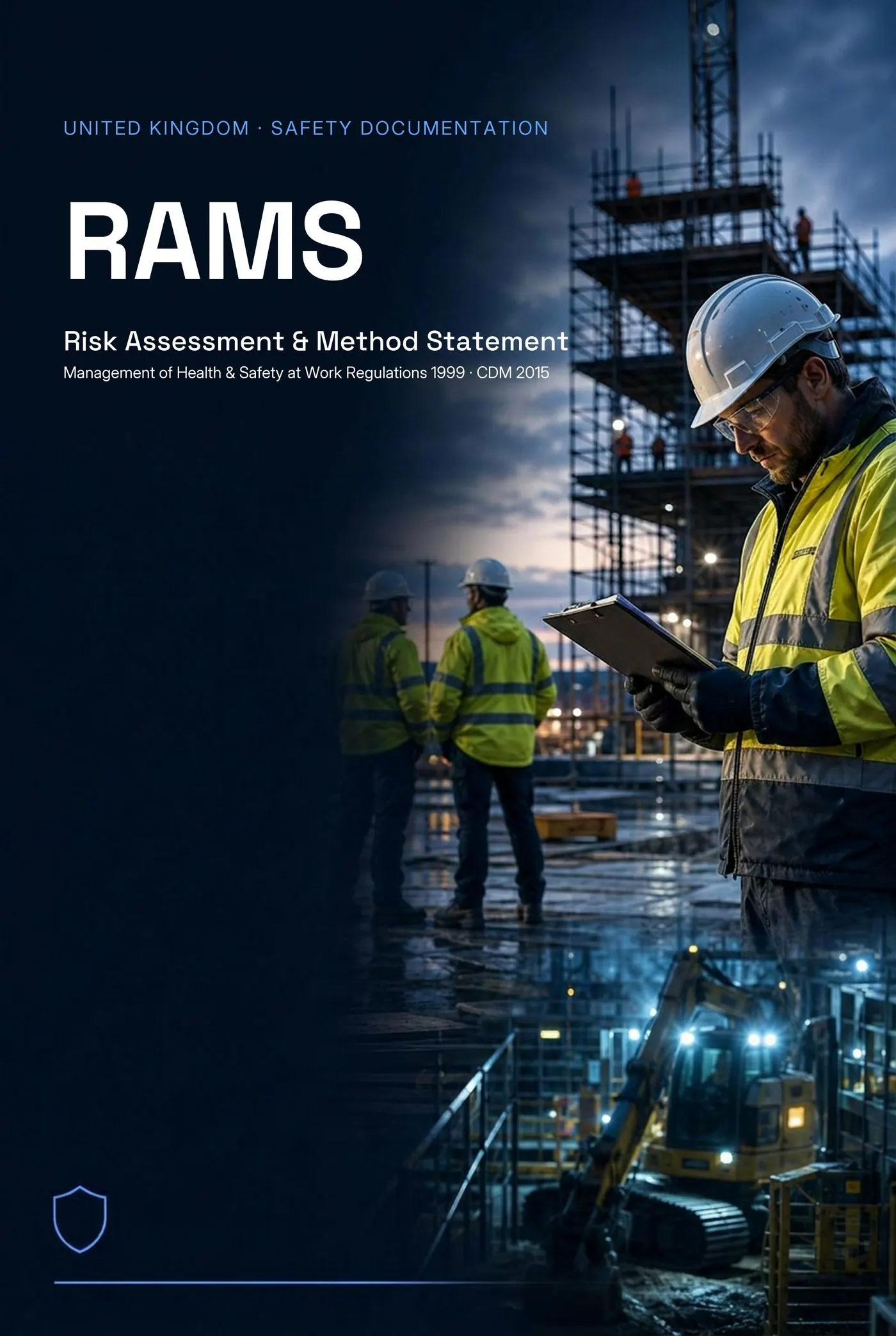
UK (RAMS) example document — Two-Storey Rear Extension — 14 Birchwood Lane, Reading. Client: Mr & Mrs A. Whitfield (Private Client). Site: 14 Birchwood Lane, Reading, RG1 5JT. Scope: Construction of a two-storey rear extension (6.4m × 4.2m) to an existing semi-detached dwelling. Works comprise breaking out of existing rear elevation, trench-fill foundations to 1.0m, traditional cavity blockwork to first floor, pre-stressed concrete lintels, timber roof structure with natural slate finish, plus alterations to existing rear wall to form structural opening with rolled steel joist (RSJ 203×102 UB23). Works programmed over 9 weeks with a peak site team of 6 operatives. Hazards assessed: Manual handling — blocks, lintels, plasterboard, Working at height — independent scaffold & roof structure, Buried services strike during excavation, Collapse of excavation / trench wall, Hand-arm vibration (HAVS) — breaking out, drilling, Silica dust — cutting blocks, brick, concrete, Vehicle/pedestrian segregation — narrow domestic street.
Full version
What does a UK manual handling risk assessment need to include?
It must follow the TILE framework: the Task (what is being lifted, carried, pushed, pulled, how often, over what distance), the Individual (capability, training, vulnerability), the Load (weight, shape, stability, ease of grip), and the Environment (floor, lighting, temperature, space). Scores from the HSE MAC tool (or ART/RAPP for repetitive and pulling tasks) should support the rating, and controls must follow the hierarchy — avoid, mechanise, redesign, reduce — before PPE.
Why generic manual handling assessments don't prevent injuries
HSE statistics show musculoskeletal disorders still account for around a third of all work-related ill health — the figure has barely shifted in a decade. The reason is consistent: most assessments tick "training provided, PPE worn" and never score the actual task. Without a MAC score for the lift, an ART score for the repetition or a RAPP score for the push, the controls are guesses. Riskora's wizard walks the four TILE axes and prompts for the relevant HSE tool. For the broader picture see the complete guide to RAMS in the UK.
How Riskora Helps
The builder asks the right questions for the actual task — single lift, repetitive lifting, team lift, push/pull, or carry — then suggests the relevant control hierarchy: eliminate, mechanise (sack trucks, hoists, MEWPs), redesign (reorganise stores, change pack sizes), reduce (split loads, increase rests), and only then PPE. Outputs include a MAC-style colour score per lift. Compare against the broader UK risk assessment software.
Who it's for
- Construction crews lifting bagged materials, blockwork and plasterboard
- Warehouse and distribution operatives picking and palletising
- Care and healthcare teams moving people (paired with the MAC patient-handling guidance)
- Landscaping and groundworks teams handling slabs, kerbs and machinery
- Office and DSE assessments where occasional lifting is part of the role
Understand the Fundamentals
Before you generate your document, these guides cover the knowledge that underpins every good RAMS, risk assessment, and method statement.
Risk Assessment Examples (UK)
Worked examples showing the depth UK reviewers expect across construction trades.
UK Risk Assessment Legal Requirements
Where MHOR 1992 sits relative to MHSWR 1999 and what 'suitable and sufficient' means in practice.
Manual Handling on Construction Sites
Construction-specific guidance — block-and-beam, scaffold components, plasterboard.
COSHH Assessment Generator
For the chemical-exposure side of jobs that also involve handling cement, solvents or sealants.
How to Write a RAMS Document
If your manual handling assessment needs to sit inside a RAMS pack.
Best UK Risk Assessment Software
Comparison of Riskora vs HandsHQ, HASpod, SafetyCulture and EcoOnline.
What does TILE stand for in manual handling?
Task, Individual, Load, Environment. It's the four-axis framework from HSE INDG143 used to structure manual handling risk assessments. Some employers add E (Equipment) to make it TILEE — the principle is identical.
Is there a weight limit for manual handling in the UK?
No statutory limit. The Manual Handling Operations Regulations 1992 (as amended) use risk-based guideline figures: roughly 25kg below waist height at the body for men and 16kg for women, dropping sharply when the load is held at arm's length or above the shoulder. The MAC tool turns those figures into red/amber/green scoring.
How often should a manual handling assessment be reviewed?
Whenever the task, load or person changes; after any near-miss or injury; and at least annually for routine work. Pregnant workers, new starters and anyone returning from injury trigger a fresh individual assessment regardless of when the task-level one was last reviewed.
Key Risks and Considerations
- •Single-person lifts above 25kg below waist (or 16kg for female workers)
- •Repetitive lifting above 12 per minute without recovery
- •Carrying any load up stairs without a free hand for the handrail
- •Pushing on uneven or sloped floors without wheel size / surface check
- •Loads with unpredictable contents (people, liquids, livestock)
What UK Law Actually Says
Direct quotes from the named regulations, with plain-English explanations of what each one means in practice.
Regulation 4, Manual Handling Operations Regulations 1992 (as amended)
“Each employer shall, so far as is reasonably practicable, avoid the need for his employees to undertake any manual handling operations at work which involve a risk of their being injured; and, where it is not reasonably practicable to avoid the need for his employees to undertake any such operations, make a suitable and sufficient assessment of all such manual handling operations to be undertaken by them, and take appropriate steps to reduce the risk of injury to those employees arising out of their undertaking any such manual handling operations to the lowest level reasonably practicable.”
Reg 4 sets the avoid → assess → reduce sequence. PPE and training are at the end of that hierarchy, not the start — an assessment that opens with 'manual handling training given' has skipped the elimination step the law requires first.
Read the source on legislation.gov.uk →HSE INDG143 — Manual handling at work: A brief guide
“The Regulations require employers to avoid hazardous manual handling so far as is reasonably practicable. Where this cannot be done, the employer must assess the risk of injury and reduce the risk of injury so far as is reasonably practicable.”
INDG143 is the practical guidance HSE inspectors use. It points assessors to the MAC, ART and RAPP tools — the same tools the Riskora wizard prompts for so the colour score is defensible.
Read the source on legislation.gov.uk →The Numbers Behind the Risk
Why this matters — the most recent published figures from the Health and Safety Executive and ONS.
473,000 workers
Suffering a work-related musculoskeletal disorder in Great Britain (2023/24). Manual handling, repetitive movement and awkward posture account for the majority — exactly the failure modes the MAC, ART and RAPP tools are designed to score before injury occurs.
Source: HSE — Work-related musculoskeletal disorders 2023/24 →7.8 million working days lost
Days lost to work-related musculoskeletal disorders in 2023/24. Most could have been prevented by an assessment that scored the task instead of recording 'training given'.
Source: HSE — Working days lost statistics 2023/24 →Side-by-side: a generic vs a passing manual handling line
Weak example. Activity: "Lifting materials on site". Hazard: "Back injury". Control: "Manual handling training provided. Wear gloves." Score: "Low". This is the line that appears in around 70% of free templates online — and it adds nothing to safe work.
Passing example. Activity: "Carrying 25kg cement bags from skip to mixer, ~12m carry, ~30 bags/shift, 4 day pour". MAC: posture green, distance amber, frequency amber, surface green — overall amber. Controls: barrow wheelbarrow for transport (engineering); split bags to 12.5kg (load redesign); rotate operative every 15 bags (fatigue control); job & finish bonus removed (pace control); FFP3 dust mask for cement dust (residual PPE). Residual MAC: green.
Why the second one passes. The lift is described with a real distance, weight and frequency. The MAC score justifies the rating. The controls are observable on site — you can stand at the mixer and verify the wheelbarrow is in use. The residual rating shows the controls actually reduce the risk.
Common Mistakes (and How to Avoid Them)
1. Recording 'training given' as the primary control
Why it fails: Training is a behavioural control near the bottom of the hierarchy. MHOR reg 4 demands avoidance and engineering controls first.
Fix: Move training to the residual-control section. Lead with avoidance, mechanisation or task redesign — the wizard surfaces these in order.
2. No MAC / ART / RAPP score on the document
Why it fails: Without a recognised tool score the assessment's risk rating is unverifiable, and a reviewer can't see whether the controls are proportionate.
Fix: Use MAC for lifts, ART for repetitive small-component work, RAPP for pushing or pulling. Record the colour or numeric score before and after controls.
3. Ignoring individual capability (new/expectant mothers, young workers, returning-to-work)
Why it fails: MHOR reg 4(3) explicitly requires the individual to be assessed, not just the task. A blanket task assessment is not 'suitable and sufficient' for those groups.
Fix: The wizard includes an individual capability block that surfaces pregnant worker, young person and post-injury return triggers.
4. No residual rating after controls
Why it fails: Without a residual score the audit trail breaks — you can't show why the remaining risk was accepted.
Fix: Score the task before and after controls. If the residual sits in red, redesign the task; if amber, document the additional measures.
Worked example: two-person lift of 28kg boilers up a flight of stairs
Scope. Domestic boiler replacements: deliver a 28kg combi boiler from the kerbside van, through the front door, up a single flight of stairs to a first-floor airing cupboard. Eight installs per day for a 3-week programme. Two-person crew.
TILE. Task: two-person team lift with a stair climb, ~9 lifts/day per person, awkward grip. Individual: two trained installers, no known capability issues. Load: 28kg, rectangular but unstable in transit (heat exchanger unbalanced), no integral handles. Environment: domestic stairs ~860mm wide, carpeted, 13-tread typical, often with a half-landing turn.
MAC score. Two-person team lift, posture score amber (twisting on the half-landing), distance amber, frequency green, communication green, surface amber. Overall amber — action needed.
Controls captured. Replace 28kg one-box lift with a powered stair-climber sack-truck (e.g. Liftkar or AAT) carried in the van; reduce the team lift to short transfers at floor and cupboard only. Pre-survey the property at quote stage to confirm stair width and turn radius. Brief the apprentice that lone lifting on stairs is prohibited. Schedule the install before lunch to avoid fatigue-driven posture drift. PPE: cut-resistant gloves and toe-protective footwear (residual, not primary).
Why it would pass review. The MAC score is shown twice — initial (amber) and residual (green) — the primary control is engineering, not PPE, the pre-survey is named as part of the elimination step, and the assessment closes with a named reviewer and re-review on any change of property type. That structure mirrors what an HSE inspector or a managed-service customer auditor expects to see.
From example to your own document
The wizard above takes a one-line description of the lift, asks the TILE questions in order, generates the MAC colour score, and downloads the assessment in the structure shown above. First PDF is free.
For COSHH-side hazards on the same job (sealants, refrigerant gases, cleaning solvents) see the COSHH assessment generator, and for the full method-statement pairing see the plumbing method statement (UK).
Key Features
- TILE-structured hazard register
- MAC / ART / RAPP scoring prompts
- Hierarchy-of-control suggestion engine
- Per-operative individual capability block
- Pregnant and new/expectant mother flagging
- Free first PDF — no card required
Example Structure (UK Standard)
- Activity: the specific lift / carry / push / pull, frequency, distance
- Task score: MAC (lifts/carries), ART (repetitive), RAPP (push/pull)
- Individual: trained, fit, pregnant/young person/returning to work
- Load: weight, shape, grip, stability, temperature
- Environment: floor, gradient, lighting, space, weather
- Controls: avoid → mechanise → redesign → reduce → PPE
- Residual: post-controls colour score per task
- Reviewer: name, IOSH/NEBOSH/competent role, date, review trigger
Common Questions Before Getting Started
Will this take long?
Under 5 minutes. Select your trade, pick hazards, download.
Is it complicated?
No training needed. The guided builder walks you through every step.
Do I need experience?
If you know what work you're doing, you can use Riskora.
Is it free to try?
Yes. The Free plan needs no card — generate, review and download one free PDF. Upgrade any time for branding, DOCX, sign-off and higher limits.
Create your RAMS in under 5 minutes
No onboarding or setup needed — start generating documents instantly
Try Riskora FreeNo card required · 1 free PDF · Upgrade any time (completely free)
All documents generated by Riskora should be reviewed by a competent person before use on site. Riskora provides structured templates — professional judgement is always required.
What your RAMS actually contains
Riskora builds a structured, client-facing document — not a generic AI paragraph. Every section is shaped around your job, your site and your team.
Hazards
Task-specific hazards for the job, captured row by row — not a generic list pulled from an old RAMS.
Controls
Control measures mapped to each hazard with residual risk scoring after controls are applied.
PPE
PPE requirements tied to the activity and site, ready to brief to the team.
Method steps
Step-by-step method statement structured around how the work is actually sequenced on site.
Emergency arrangements
First aid, rescue plan, emergency contacts and site-specific escalation routes.
COSHH prompts
Substance prompts when the work involves chemicals, dusts, fumes or sealants — flagged early, not missed at review.
Sign-off
Operative sign-off captured against the document — names, dates and acknowledgement of the brief.
Version history
Every change tracked so you can show what was issued, when, and which version the team signed.
Approval status
Clear approval state on every document — draft, in review, approved, issued — visible across the team.
Audit trail
Who created it, who reviewed it, who signed it. A complete trail you can hand to a principal contractor or auditor.
From copied-and-pasted to site-specific
The reason RAMS get rejected is rarely the format — it's that the document is obviously generic. Riskora rebuilds it around this job, this site and this task.
Generic template copied from an old job.
- • Hazards and controls that don't match this site or task.
- • Method steps written for a different sequence of work.
- • No emergency arrangements specific to the location.
- • Client flags it as generic and asks for a rewrite.
Site-specific document structured around this job, site and task.
- • Hazards captured from the actual scope you pasted in.
- • Method steps sequenced for how the work runs on site.
- • Emergency arrangements and rescue plan tied to the location.
- • Approved internally, briefed to the team, signed off and stored.
From job details to signed-off document
A four-step workflow used by contractors, consultants and safety teams to turn informal job details into client-ready safety paperwork.
- 1Paste job details
Drop in a client email, a WhatsApp from the site manager, a scope of works or a tender note. Anything that describes the job.
- 2Riskora structures the document
Riskora turns your brief into hazards, controls, method steps, PPE, emergency arrangements and COSHH prompts.
- 3Review, edit and download
You stay in control of every section. Tweak anything, then download a clean PDF or share a link.
- 4Brief the team and record sign-off
Brief operatives, capture their sign-off and keep a full audit trail of who signed which version.
Built by people who've written this paperwork on real sites
Riskora is built by a founder with hands-on site and document experience — designed for contractors, consultants and safety teams who need to issue, brief and prove safety paperwork without losing a day to admin.
- Built for contractors, consultants and teams
Solo trades, principal contractors and in-house safety teams all run on the same workflow. - Supports multiple countries
UK, Ireland, Australia, New Zealand, US and Canada — wording and document types match the local standard. - Not just documents
Sign-off, approvals, version history and an audit trail — the management workflow around the paperwork.
Frequently Asked Questions
Describe your job — your draft is one paragraph away.
No training. No complex setup. Just select your trade and go.
References & Further Reading
Primary UK sources covering the legal and practical framework behind RAMS, risk assessments and method statements.
Create your manual handling RAMS free — preview before sign-up
Generate a preview first. Sign up only when you want to save, edit or export.
Final RAMS must be reviewed and approved by a competent person before use.
Riskora is an assistive document preparation tool. All documents generated must be reviewed, verified, and approved by a competent person before use on site. Riskora does not replace professional safety judgment, and no output should be treated as a legal compliance guarantee.