RAMS for Railway Construction (UK) – Generate in Minutes
By the Riskora Editorial Team · Reviewed against our editorial standards · Last reviewed
Generate structured RAMS for railway construction — covering PTS requirements, working in possessions, OLE proximity, track-level hazards, and Network Rail standards.
UK (RAMS) example document — Two-Storey Rear Extension — 14 Birchwood Lane, Reading. Client: Mr & Mrs A. Whitfield (Private Client). Site: 14 Birchwood Lane, Reading, RG1 5JT. Scope: Construction of a two-storey rear extension (6.4m × 4.2m) to an existing semi-detached dwelling. Works comprise breaking out of existing rear elevation, trench-fill foundations to 1.0m, traditional cavity blockwork to first floor, pre-stressed concrete lintels, timber roof structure with natural slate finish, plus alterations to existing rear wall to form structural opening with rolled steel joist (RSJ 203×102 UB23). Works programmed over 9 weeks with a peak site team of 6 operatives. Hazards assessed: Manual handling — blocks, lintels, plasterboard, Working at height — independent scaffold & roof structure, Buried services strike during excavation, Collapse of excavation / trench wall, Hand-arm vibration (HAVS) — breaking out, drilling, Silica dust — cutting blocks, brick, concrete, Vehicle/pedestrian segregation — narrow domestic street.
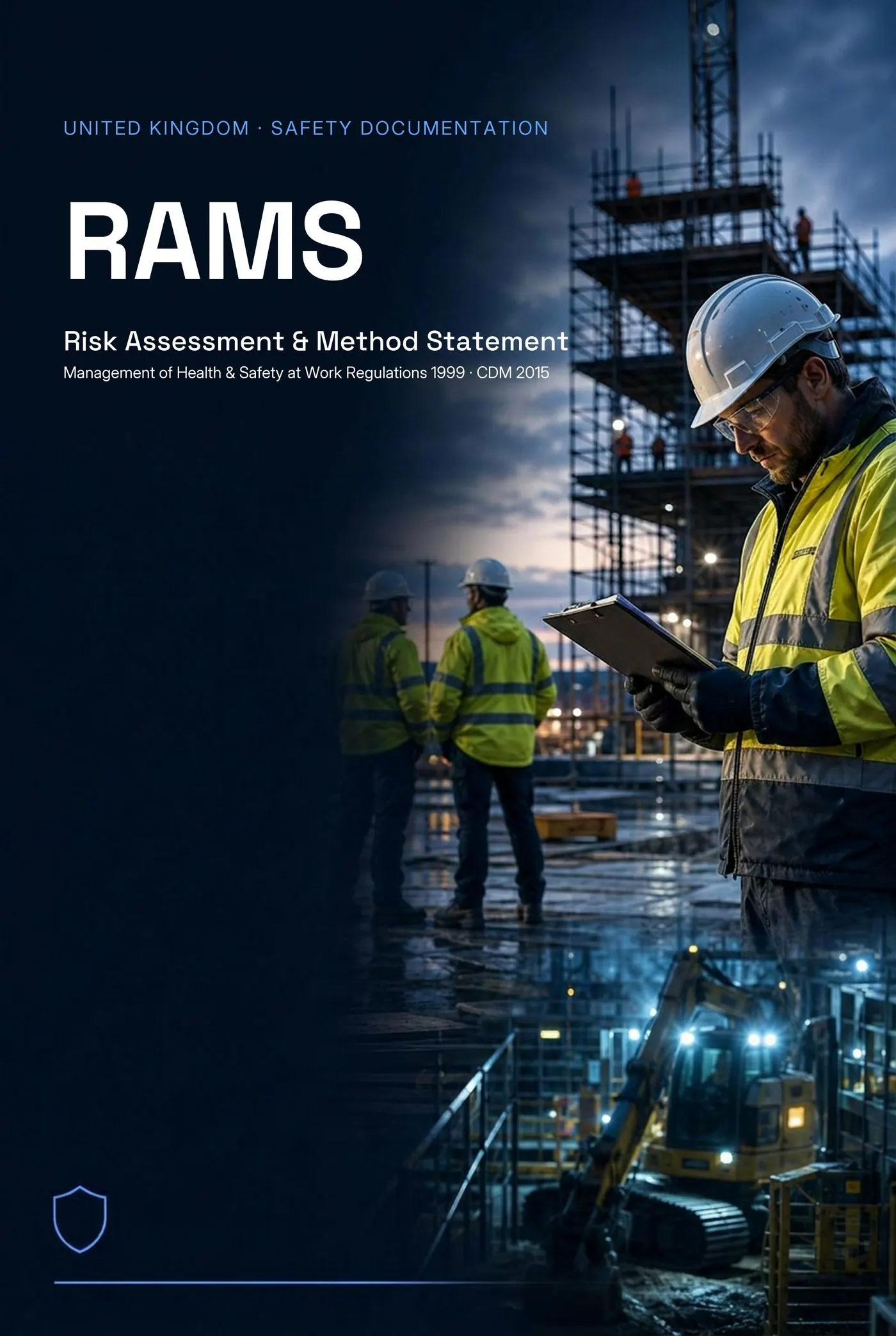
Full version
Takes less than 5 minutes
No card required · 1 free PDF · Upgrade any time (completely free)
What should a railway construction RAMS include?
A railway RAMS must cover the specific rail environment (open track, station, depot), possession type and safe system of work, OLE proximity and electrical isolation requirements, PTS (Personal Track Safety) competence for all personnel, COSS (Controller of Site Safety) arrangements, lookout protection where applicable, interface with live rail traffic, plant certification for on-track use, and emergency procedures including rail-specific evacuation routes.
What is a railway RAMS?
A railway RAMS is a combined Risk Assessment and Method Statement prepared for construction, maintenance, or renewal work within the railway boundary. Railway RAMS must comply with Network Rail standards and the Rail Safety and Standards Board (RSSB) guidance. They are significantly more complex than standard construction RAMS because they must address the unique hazards of working near live rail traffic, overhead line equipment (OLE), and third-rail electrification, in addition to standard construction risks.
Railway Work Operates Under Its Own Safety Regime
Construction work on or near the railway isn't governed by CDM 2015 alone — it falls under the Railways and Other Guided Transport Systems (Safety) Regulations 2006 (ROGS) and must comply with Network Rail company standards. Every worker needs PTS certification. Every site needs a COSS or Safe Work Leader. Access requires a possession, line block, or lookout protection. Plant must be certified for on-track use. OLE isolation has its own permit system. A standard construction RAMS doesn't cover any of this. Railway RAMS need to address the specific rail safe system of work alongside the construction methodology. Understanding the legal requirements for risk assessments in the UK is the first step toward getting your documentation right.
The railway environment presents unique hazards including moving trains, electrification (25kV OLE or 750V third rail), and the specific constraints of working in possessions with strict time limits. RSSB data shows that the interface between rail operations and construction activity remains a significant risk area requiring robust planning and documentation.
How Riskora Helps
Riskora generates railway-specific RAMS covering the rail safe system of work alongside construction hazards. Specify your work location (open track, station, depot), access arrangements (possession, line block, lookout), and OLE status, and the tool generates hazards and controls for both the rail environment and the construction activity. Add your PTS/COSS arrangements, plant details, and method steps, then download a professional document suitable for submission to Network Rail or the principal contractor. For more complex projects, you may also need a standalone risk assessment or method statement.
Who it's for
- Track renewal and maintenance contractors working in possessions
- Signal and telecoms teams installing equipment near live lines
- Civil engineering contractors building structures within railway boundary
- OLE contractors working on overhead line equipment
- Station improvement teams working on platforms and concourses
- Earthworks contractors managing embankments and cuttings near live railway
Understand the Fundamentals
Before you generate your document, these guides cover the knowledge that underpins every good RAMS, risk assessment, and method statement.
What Is a RAMS Document?
Understand the two components of a RAMS and why they're required before work begins on site.
How to Write a RAMS Document
A step-by-step guide to structuring your RAMS from project details through to sign-off.
UK Legal Requirements for Risk Assessments
What the law requires under MHSWR 1999 and CDM 2015, and what 'suitable and sufficient' means.
Who Needs a RAMS?
Find out whether your work requires a RAMS and who is responsible for producing one.
Construction Safety Documents Explained
An overview of the key safety documents required on UK construction sites and how they relate to each other.
How to Write a RAMS (UK Guide)
A practical walkthrough of writing RAMS from scratch, covering structure, common mistakes, and what reviewers look for.
Do I need PTS to work on the railway?
Yes. All personnel working within the railway boundary must hold a valid PTS (Personal Track Safety) certificate. This is a mandatory requirement enforced by Network Rail. PTS training covers the dangers of the railway environment, the safe system of work, and what to do in an emergency. Your RAMS must confirm that all personnel hold current PTS certification.
What is a COSS and why does my RAMS need one?
A COSS (Controller of Site Safety) is the person responsible for implementing the safe system of work on site. They ensure that all workers are protected from train movements, that the limits of the work area are defined, and that everyone is accounted for. Your RAMS must name the COSS and describe their role in the safe system of work.
Key Risks and Considerations
- •Being struck by a train — working on or near live lines without adequate protection
- •Electrocution from OLE (25kV AC) or third rail (750V DC) contact
- •Failing to clear the line before a possession is handed back
- •Plant or materials fouling the running line
- •Working beyond the limits of a possession or line block
- •Inadequate lookout protection on open lines
- •Falls from height — platform edges, overbridges, signal gantries
- •Manual handling of rail, sleepers, and ballast
- •Noise from rail grinding, tamping, and construction plant
- •Fatigue from extended possession working (often overnight or weekends)
Key Features
- Railway-specific safe system of work presets
- PTS and COSS competence documentation
- OLE proximity and isolation controls
- On-track plant certification references
- Possession and line block arrangements
- Rail and construction hazard libraries combined
- Emergency procedure templates (rail-specific)
- Download to PDF — Network Rail submission ready
Example Structure (UK Standard)
- Work location and rail environment description
- Safe system of work (possession, line block, lookout protection)
- COSS/Safe Work Leader arrangements
- OLE status and electrical isolation requirements
- PTS and competence requirements for all personnel
- Construction methodology and sequence
- Plant and equipment (on-track plant certification)
- Hazard identification with risk ratings
- Control measures for rail and construction hazards
- PPE requirements (hi-vis to rail standard, hearing protection)
- Emergency procedures (rail-specific evacuation)
- Possession handback procedure
Common Questions Before Getting Started
Will this take long?
Under 5 minutes. Select your trade, pick hazards, download.
Is it complicated?
No training needed. The guided builder walks you through every step.
Do I need experience?
If you know what work you're doing, you can use Riskora.
Is it free to try?
Yes. The Free plan needs no card — generate, review and download one free PDF. Upgrade any time for branding, DOCX, sign-off and higher limits.
Create your RAMS in under 5 minutes
No onboarding or setup needed — start generating documents instantly
Try Riskora FreeNo card required · 1 free PDF · Upgrade any time (completely free)
All documents generated by Riskora should be reviewed by a competent person before use on site. Riskora provides structured templates — professional judgement is always required.
"On the railway, your RAMS isn't just a document — it's the plan that keeps your team alive in an environment where a train can appear with seconds of warning."
What your RAMS actually contains
Riskora builds a structured, client-facing document — not a generic AI paragraph. Every section is shaped around your job, your site and your team.
Hazards
Task-specific hazards for the job, captured row by row — not a generic list pulled from an old RAMS.
Controls
Control measures mapped to each hazard with residual risk scoring after controls are applied.
PPE
PPE requirements tied to the activity and site, ready to brief to the team.
Method steps
Step-by-step method statement structured around how the work is actually sequenced on site.
Emergency arrangements
First aid, rescue plan, emergency contacts and site-specific escalation routes.
COSHH prompts
Substance prompts when the work involves chemicals, dusts, fumes or sealants — flagged early, not missed at review.
Sign-off
Operative sign-off captured against the document — names, dates and acknowledgement of the brief.
Version history
Every change tracked so you can show what was issued, when, and which version the team signed.
Approval status
Clear approval state on every document — draft, in review, approved, issued — visible across the team.
Audit trail
Who created it, who reviewed it, who signed it. A complete trail you can hand to a principal contractor or auditor.
From copied-and-pasted to site-specific
The reason RAMS get rejected is rarely the format — it's that the document is obviously generic. Riskora rebuilds it around this job, this site and this task.
Generic template copied from an old job.
- • Hazards and controls that don't match this site or task.
- • Method steps written for a different sequence of work.
- • No emergency arrangements specific to the location.
- • Client flags it as generic and asks for a rewrite.
Site-specific document structured around this job, site and task.
- • Hazards captured from the actual scope you pasted in.
- • Method steps sequenced for how the work runs on site.
- • Emergency arrangements and rescue plan tied to the location.
- • Approved internally, briefed to the team, signed off and stored.
From job details to signed-off document
A four-step workflow used by contractors, consultants and safety teams to turn informal job details into client-ready safety paperwork.
- 1Paste job details
Drop in a client email, a WhatsApp from the site manager, a scope of works or a tender note. Anything that describes the job.
- 2Riskora structures the document
Riskora turns your brief into hazards, controls, method steps, PPE, emergency arrangements and COSHH prompts.
- 3Review, edit and download
You stay in control of every section. Tweak anything, then download a clean PDF or share a link.
- 4Brief the team and record sign-off
Brief operatives, capture their sign-off and keep a full audit trail of who signed which version.
Built by people who've written this paperwork on real sites
Riskora is built by a founder with hands-on site and document experience — designed for contractors, consultants and safety teams who need to issue, brief and prove safety paperwork without losing a day to admin.
- Built for contractors, consultants and teams
Solo trades, principal contractors and in-house safety teams all run on the same workflow. - Supports multiple countries
UK, Ireland, Australia, New Zealand, US and Canada — wording and document types match the local standard. - Not just documents
Sign-off, approvals, version history and an audit trail — the management workflow around the paperwork.
Frequently Asked Questions
Ready? It takes less than 5 minutes.
No training. No complex setup. Just select your trade and go.
Start Your RAMS Now — It's FreeNo card required · 1 free PDF · Upgrade for branding, DOCX, sign-off and audit trails (completely free)
References & Further Reading
Primary UK sources covering the legal and practical framework behind RAMS, risk assessments and method statements.
Create your railway construction uk RAMS free — preview before sign-up
Generate a preview first. Sign up only when you want to save, edit or export.
Final RAMS must be reviewed and approved by a competent person before use.
Riskora is an assistive document preparation tool. All documents generated must be reviewed, verified, and approved by a competent person before use on site. Riskora does not replace professional safety judgment, and no output should be treated as a legal compliance guarantee.